
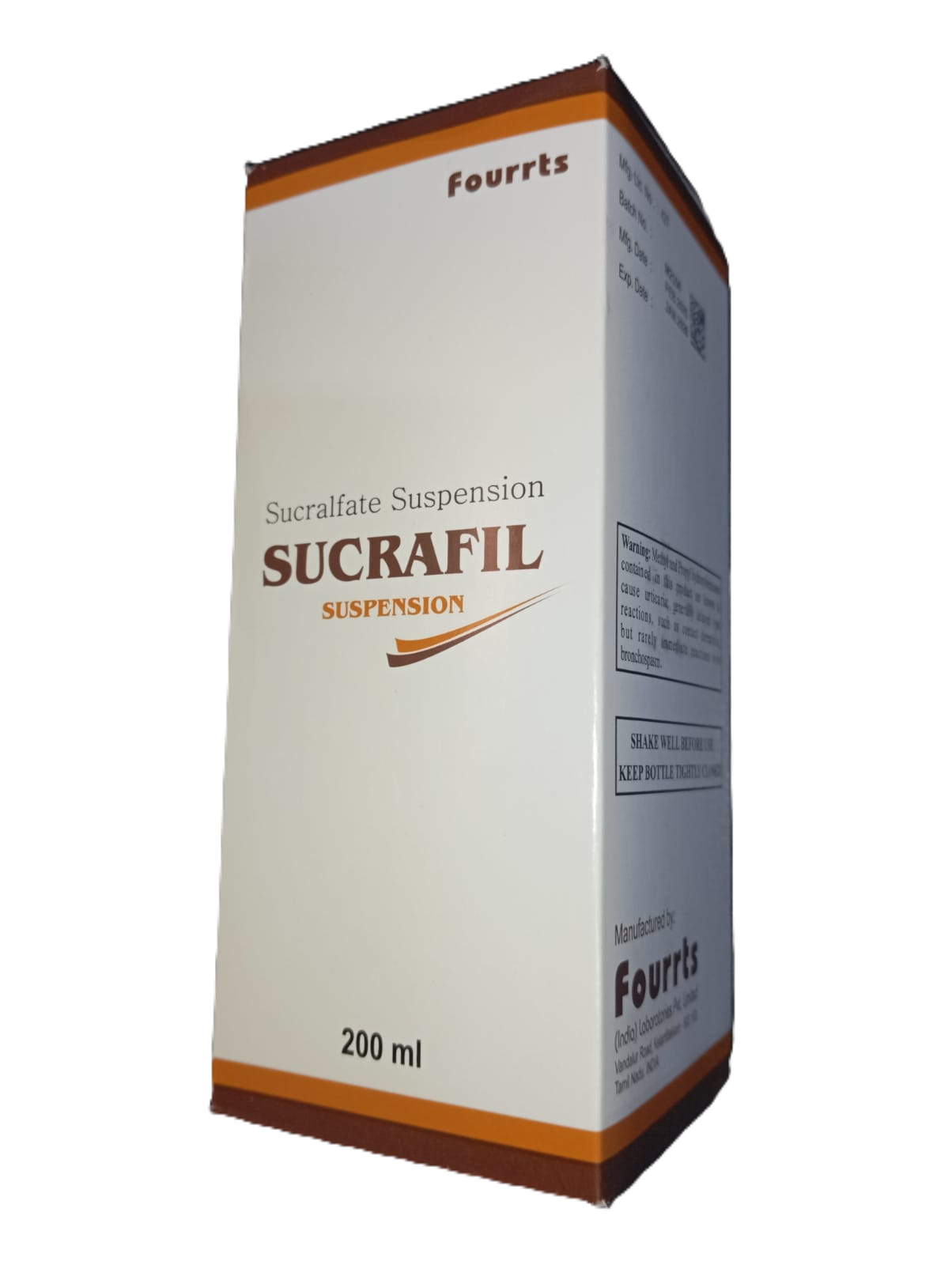
Description
Ingredients of Sucrafil Suspension
Ingredients for 10ml
|
Ingredient information |
Content |
|---|---|
|
Sucralfate |
1g |
Uses of Sucrafil Suspension
Assign
Sucrafil is indicated in the following cases:
- Short-term treatment of active duodenal ulcer (up to 8 weeks) in duodenal ulcer disease.
- Prophylaxis of duodenal ulcer recurrence
- Treatment of benign gastric ulcers
- Combination in the treatment of arthritis: To eliminate gastrointestinal symptoms associated with the treatment of arthritis with non-steroidal anti-inflammatory drugs.
- Treatment or prevention of stress-induced gastrointestinal mucosal damage (ulcers and bleeding), especially in patients undergoing intensive care.
- Treatment of gastroesophageal reflux disease.
Pharmacodynamics
Pharmacological group: Drugs acting on the digestive tract.
ATC code: A02BX02
Sucralfate is an anti-ulcer agent that inhibits the proteolytic action of pepsin. It forms a protective film over the inflamed or ulcerated area of the stomach and protects the gastric mucosa against the absorption of pepsin, trypsin and bile acids. Sucralfate – a complex of aluminum sucrose hydrogen sulphate – is a mucosal protectant. In the stomach (pH < 4) it polymerizes and forms viscous polymers that adhere to the ulcer site (both gastric and duodenal), protecting the ulcer epithelium from the action of ulcerogenic substances such as gastric acid, pepsin and bile. Sucralfate also directly absorbs bile and pepsin.
Sucralfate binds to phosphorus in the gastrointestinal tract and reduces plasma phosphorus concentrations, while calcium concentrations may increase. Sucralfate also helps protect the ulcer surface from further damage by inhibiting the enzyme pepsin, which breaks down mucosal proteins. Sucralfate increases prostaglandin E2 synthesis and gastric mucosal protection. It also binds to epithelial growth factor and fibroblast factor.
Pharmacokinetics
Up to 5% of the disaccharide portion and less than 0.02% of the aluminum are absorbed into the body after an oral dose of sucralfate. Most of the drug is excreted in the feces, with only a small amount of the disaccharide sulfate excreted in the urine.
How to use Sucrafil Suspension
Use
Oral medication.
Dosage
The usual adult dose is 10 ml of suspension x 3 – 4 times/day between meals and before bedtime.
Short-term treatment of active duodenal ulcers
The recommended dose for adults with duodenal ulcers is 10 ml (equivalent to 1 g) x 4 times/day, taken 1 hour before each meal and before going to bed or 20 ml (equivalent to 2 g) x 2 times/day, on waking and before going to bed on an empty stomach. Antacids may be prescribed as needed for pain relief but should not be taken within half an hour before or after taking sucralfate. While healing may occur within the first 1 – 2 weeks of treatment, it should be continued for 4 – 8 weeks, unless endoscopy or X-ray results show that the ulcer is completely healed.
Prophylactic treatment of duodenal ulcers or maintenance treatment after healing of duodenal ulcers
10 ml x 2 times/day, taken half an hour before breakfast and dinner on an empty stomach. Treatment should be continued for 12 months. Usually, maintenance treatment with Sucrafil suspension alone is effective in patients with gastric ulcers, however, a short-term treatment combined with analgesics and antispasmodics may bring greater benefit in some patients with new clinical manifestations, especially patients with severe epigastric pain.
Short-term treatment of benign gastric ulcer and gastrointestinal symptoms associated with treatment of arthritis with non-steroidal anti-inflammatory drugs
10 ml suspension x 3 or 4 times/day between meals and before bedtime.
Treatment and prevention of stress-induced mucosal damage
10 ml suspension x 4 times/day between meals and before bedtime for no more than 14 days.
Gastroesophageal reflux
10 ml suspension x 3 or 4 times/day between meals and before bedtime.
Senior Citizen
Caution should be exercised when selecting a dose for elderly patients, usually starting at the low end of the dose range because elderly patients often have decreased cardiac, renal, or hepatic function and have concomitant diseases or are taking other medications.
Note: The above dosage is for reference only. The specific dosage depends on your physical condition and the progression of the disease. For the appropriate dosage, you should consult your doctor or health professional.
What to do in case of overdose?
Ingestion of large amounts of the drug may cause gastrointestinal disturbances such as dyspepsia, abdominal pain, nausea and vomiting. Since there is little experience with overdosage of sucralfate in humans, no specific treatment for overdosage with sucralfate can be recommended. Sucralfate is poorly absorbed from the gastrointestinal tract and therefore the risk of acute overdosage is very low.
In case of overdose, most patients are asymptomatic. Treatment should be symptomatic and supportive.
What to do if you miss a dose?
If you miss a dose, take it as soon as possible. However, if it is close to the time for your next dose, skip the missed dose and take your next dose at the regular time. Do not double your dose.
Side effects
When using Sucrafil, you may experience unwanted side effects (ADR).
Common, ADR > 1/100
- Digestion: Constipation and diarrhea.
Frequency unknown
- Digestive: Diarrhea , nausea, stomach upset, dry mouth.
- Nervous system: Dizziness, drowsiness.
- Other: Skin rash, itching and back pain.
- Body as a Whole: Allergic reactions (including urticaria, angioedema, dyspnea, rhinitis, laryngospasm and facial edema).
ADR Handling Guide
If you experience side effects, stop using the drug and notify your doctor or go to the nearest medical facility for timely treatment.
Note
Before using the drug, you need to read the instructions carefully and refer to the information below.
Contraindications
Sucrafil is contraindicated in the following cases:
- Patients who are sensitive to any ingredient of the drug.
- Children under 15 years old.
Use with caution
Use this drug with caution in patients with renal failure as it may increase aluminum absorption.
In patients with severe renal impairment or on haemodialysis, sucralfate suspension should be used with extreme caution and for short periods only. Concomitant treatment with aluminium-containing drugs is not recommended due to the possibility of toxic aluminium absorption. Sucralfate suspension may also cause allergic reactions (possibly delayed).
Duodenal ulcers are chronic, recurrent diseases. While short-term treatment with sucralfate can result in complete healing of ulcers, successful treatment with sucralfate is not thought to alter the frequency of recurrence or the severity of duodenal ulcers.
Safety and efficacy have not been established for use longer than 12 months. If patients experience bloating, nausea, vomiting, or abdominal pain after eating, they should consult a physician immediately.
Inadvertent injection of sucralfate and insoluble excipients can lead to fatal complications, including cerebral and pulmonary embolism. Therefore, sucralfate should not be administered intravenously. The use of sucralfate and tube feeding should be separated by approximately 1 hour due to the risk of benzoar formation with sucralfate. Bezoars (insoluble fragments formed with the gastric lumen) have occasionally occurred in patients receiving Sucrafil suspension. Most of these patients already have a risk of benzoar formation in the stomach, such as: delayed gastric emptying or use of tube feeding.
Ability to drive and operate machinery
Use of Sucrafil may cause drowsiness especially when taken with alcohol and may be dangerous when driving or operating machinery or any activity requiring high mental alertness.
Pregnancy
Because there are no adequate and well-controlled studies of sucralfate use in pregnant women, Sucrafil should be used during pregnancy only if clearly needed.
Breastfeeding period
It is not known whether the drug is excreted in human milk. Therefore, caution should be exercised when Sucrafil is administered to a nursing patient.
Drug interactions
Concomitant use of Sucrafil suspension may reduce the bioavailability of certain drugs including: Tetracycline, ciprofloxacin, norfloxacin, ketoconazole, digoxin, phenytoin, theophylline, thyroxine, quinidine and H2 receptor antagonists.
The bioavailability of these drugs is not affected if they are taken 2 hours apart from Sucrafil. The mechanism of this interaction is not due to systemic absorption, but is primarily the result of sucralfate binding to the concomitantly administered drugs in the gastrointestinal tract. Since Sucrafil may alter the gastrointestinal absorption of some drugs, consideration should be given to separate administration of Sucrafil and other drugs if concomitant use significantly alters the bioavailability of these drugs.
Concomitant use of sucralfate and antacids is not recommended because antacids may interfere with the binding of sucralfate to the mucosa. Therefore, it is recommended that sucralfate and antacids be administered 30 minutes apart.
Sucrafil and tube nutrition should be separated by approximately 1 hour in patients receiving sucrafil to prevent stress-induced peptic ulcers. In rare cases, benzoar formation has been reported due to close administration of sucrafil and tube nutrition.
Preserve
Store below 30°C. Protect from sunlight.
Reviews
There are no reviews yet.